Judgement
What is Judgement
Judgement is a social deception board game where players need to convince the Judge who the murderer is in the group whilst maintaining innocents. At the end of the round the Judge player chooses 1 person from the group to be executed if the Judge correctly executed the murderer the Innocent team wins, however if they Judge executes the wrong person the Guilty team wins.
The game sessions last around 5 minutes and each round players redraw cards, there is a narration companion app to narrate the players powers during the sleeping phase and count the time in the rounds after the game begins.
Print and play
The first version of Judgement is available for download as an APK for android online as well as a print and play version of the cards and rules. Click the link below or scan the QR code to access the download folder.

Rules and gameplay
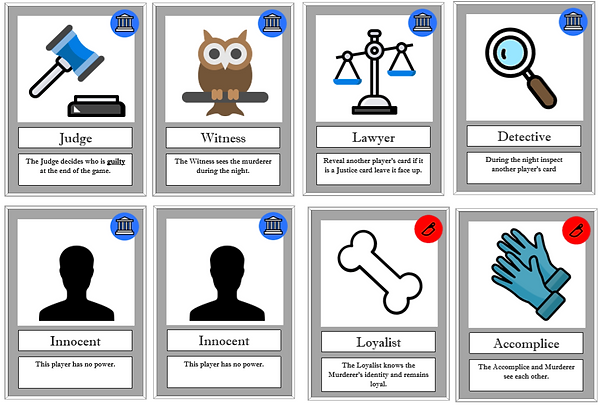
Judgement is a social deception game where players need to lie to each other to convince the group and most importantly the Judge who is who and where each player’s allegiances lie. Before the game begins each player draws a card with a unique power which will be used in the night phase, these powers include inspecting other players cards, seeing specific players roles and even choosing a side.
Judgement is a game that runs in two phases, the first phase often called the night phase, is a phase where players close their eyes or sleep until their specific role cards power is activated. The narrator on the companion app will read out each roles name and instruct them to use their powers, at this time the called players may open their eyes and do as their cards power instructs. After all the player card powers have been used the narrator will call for all players to wake up and begins the second phase.
At the beginning of the second phase the Judge player will reveal their card for all players to see and leave it face up. Now the timer beings and the players may begin discussion in order to convince the Judge who is guilty and who is innocent.
Finally after the allotted time has concluded the Judge will decide who is guilty and convict the player they have chosen, the chosen player then reveals their card if the card is a Justice card the Guilty team wins, however if the card shown is the Murderers card the Justice team wins.
Companion app
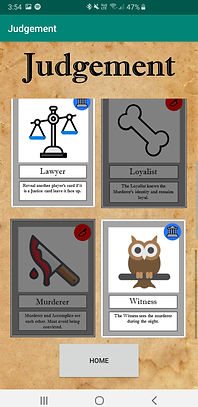
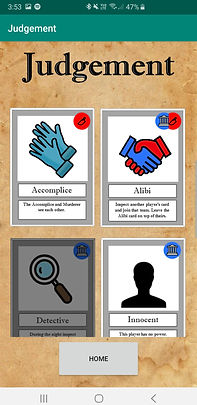
Judgement come with a companion app ready to narrate the game rules for you and your friends so no one has to miss out on playing the game to narrate. The companion app allows the user to select and deselect which cards will be used during the game as seen below, additionally the app counts down the discussion timer after the narration phase has ended.
The companion app was created using Android Studio written in Kotlin over a 3 week period, the available version is only the first version and has some known bugs and other issues which I will continue to work on when I begin development again.

Project rational
I wanted to challenge myself and develop a game with limited rules to allow the players for fully express themselves and create their own enjoyment through the interaction with each other. This along with my own playing experience led me to the idea of creating a social deception game similar to the likes of Werewolf, Mafia and Secret Hitler.
As we have seen the rebirth of the board game industry with modern social deception games usually developed with the help of sites like “Kick Starter” and “GoFundMe” it both gave me motivation to start thinking of my own variation as well as confidence that the concept of social deception games is both popular and successful.
The amount of funding board games receive on Kick Start has continued to grow from 2013 at $29 million to 2018 reaching almost $80 million. Some of the top performing games include Tainted Grail: The Fall of Avalon whose initial goal of $50,000 was smashed reaching over $2 million funded. Similarly Deep Madness beat its goal by $800,000 these games show that players want all they can get from this industry and with many more and more success stories similar to these happening every year it seems to be very likely to continue to grow.
Developing a board game is a different challenge entirely from a video game, the rules have to be very clear and created in a way that can’t be abuse whilst also remaining simple enough that they can be easily followed without a system constantly checking for the players.
The main skills I want to work on with this project is design focused on player interaction with each other rather than interaction with a video game. I often hear from people that the main reason the play games is to chat with friends whilst doing something together, and that inspired me to want to develop around that mindset.
Additionally I want to fully design and develop a game that uses physical items and a companion app, this will help improve my ability to create consistent design across multiple platforms. Furthermore with the development of a companion app I will be able to experience the release process and promotion of software through app stores on various platforms.
The core concept of what I’m currently calling Witness Protection is a social deception game where each player is given a role with different powers or abilities. Each role will be a character which the player will become, additionally each of these character are aligned to different teams. One player will be given a very unique role of the “Witness” who is not aligned to either team and has full information of each player’s character, power and alignment, however this player is at the most risk as the bad team want to eliminate them to protect the vital information they possess.
The goal of the game is for the good team to figure out who the Witness is to protect them whilst similarly eliminating members of the bad team. The bad team’s goal is to figure out who the Witness is to eliminate them while also deceiving the other players on their bad alignment. Lastly the goal of the Witness is to survive the rounds until the good team has figured out who they are by dropping hints that are subtle enough to prove your innocents while not so obvious that the bad team could get to them first.
The project current name "Witness Protection"
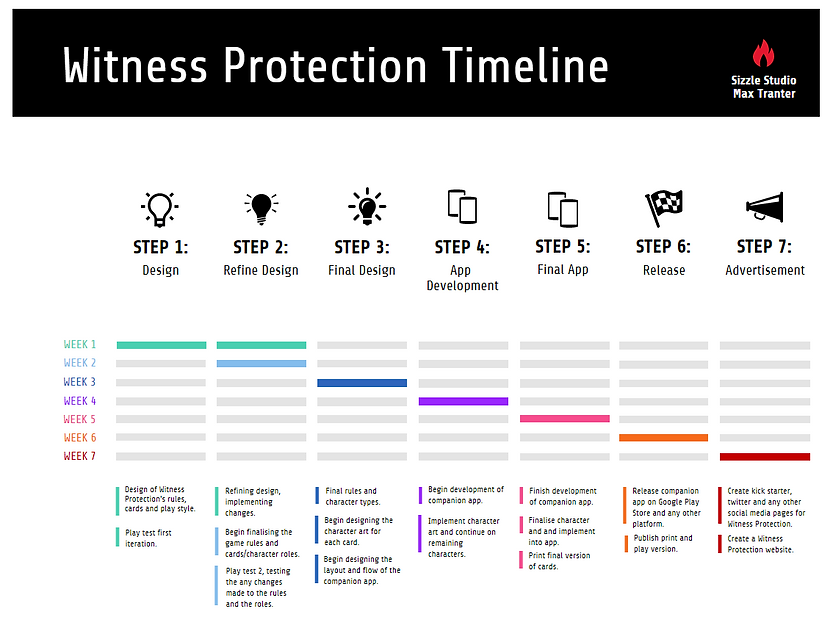
Week 1
The first week of development included a very simple paper prototype to begin testing the rules I envisioned. The play test game me a significant amount of information about the issues with Witness Protections main goals and rules. Many players had no reason to lie to each other or even talk at all. Further with discussion with the play testers I gained a lot of new ideas on how I could improve these issues.
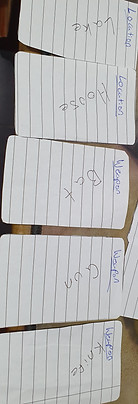
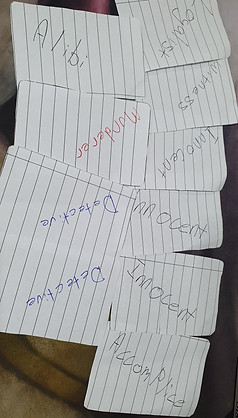
Left: Player Role Cards
Below: Evidence Cards
The second week of development came with a huge amount of changes to the rules and main goals of Witness Protection in order to streamline gameplay as well as creating a much simpler and easier to learn game. These changes included the removal of Evidence cards to focus exclusively on the Player Role cards, this paired with a change of focus onto the role called "Judge" shaped the game. To summaries from week 1 to 2 the games rules went from finding and protecting the Witness to convincing the Judge who the Murderer is with the help of the Witness and many other roles in the game. The play tests for the updated rules proved much more successful as players were lying to each other and laughing as they tried to convince the Judge who was who. And further the Judge player had trouble many games figuring out exactly who everyone was even if they were able to successfully pick out the Murderer.
Week 2
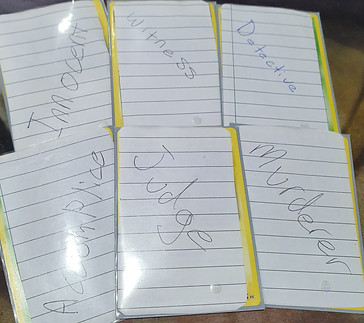
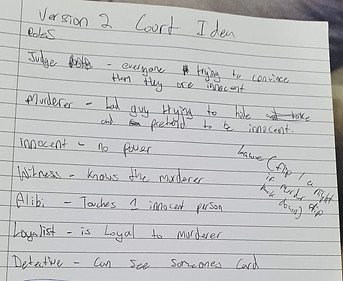
Left: Player Role Cards
Above: Role Powers
Week 3
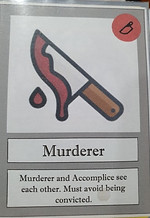
Now that the rules were all but set in stone I could begin designing the cards and the different symbols that would represent each role.
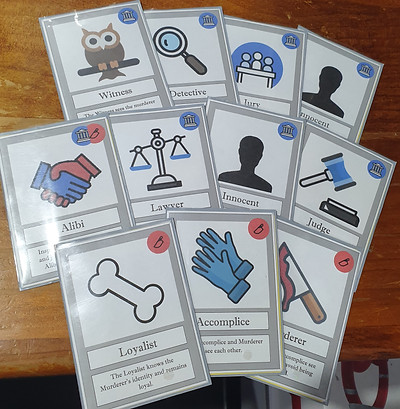
All Role Cards
Judge card
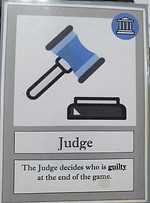
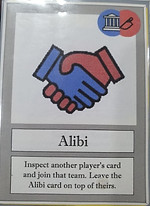
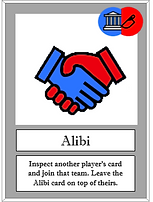
Alibi card
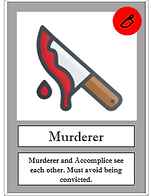
Murderer card
Week 4
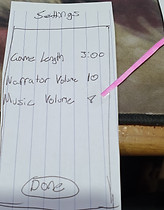
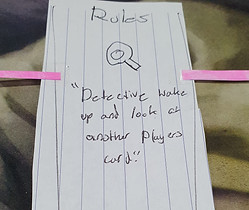
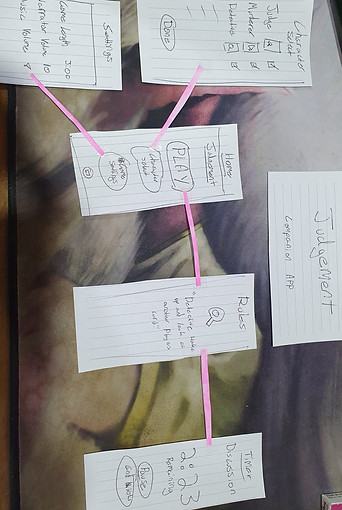
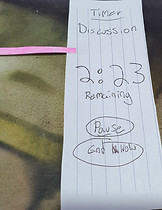
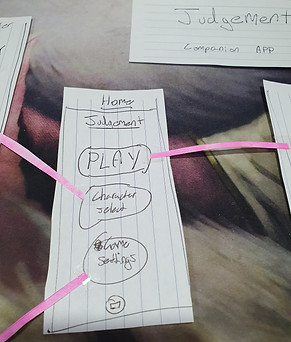
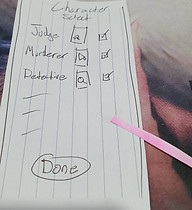
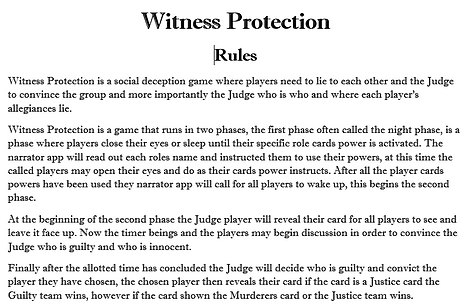
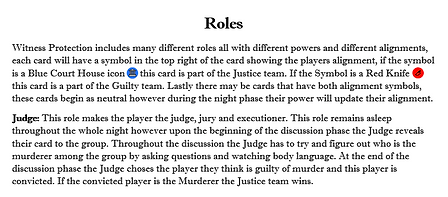
Now that Witness Protection had both a solid set of rules and all the cards designed I could begin working on the design of the companion app i envisioned to run along side the game. Additionally during this week I took the time to write all the rules for the game out in long form in its own document like a commonly seen rule book.
Week 5
After laying out the design for the app it was time to start building the app. I decided to use Android Studio using Kotlin to code as I had never coded in Kotlin before and thought it would be a good opportunity to learn.
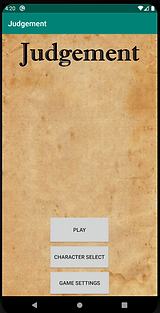
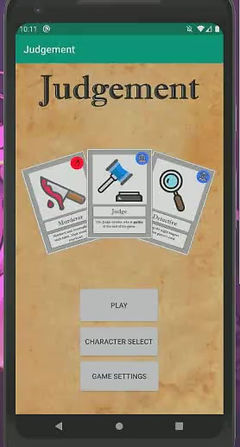
The image on the right is the beginnings of the app which is now being called Judgement as I think it fits more in with the goals of the players whilst playing.
The home screen functions simply as a station to each of the other screens where players will be able to change how the game functions.
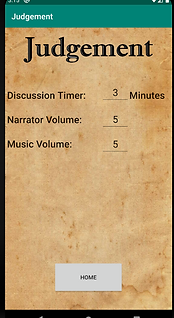
The Play button will start the game, the Character Select button is where players can choose what roles will be in the game and how many players are playing and the Game Settings button will allow players to change the discussion length, narrator volume and music volume.
Week 6
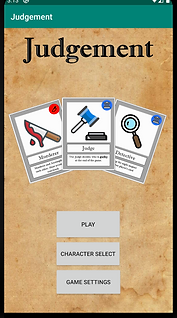
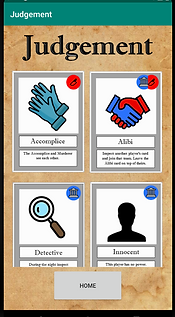
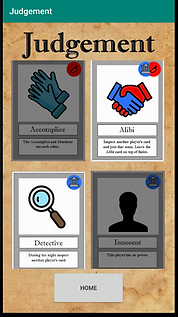
Another week of development and I have most of the screens working to some degree and a cleaner visual design. The most import screen to the app is the Character Select screen which shows every card from Judgement.
Players can pick each of the cards to disable them or enable them in the narrator's explanation once the game begins. As can be seen in the images once a card has been deselected they are darken to show that they are currently disabled.
As this is my first venture into app development, Android Studios and Kotlin I was running into a lot of issues specifically with maintaining variables for the enabled or disabled cards. Regardless of the issues I was able to create a good looking character select screen where players are able to understand exactly what is and isn't going to be in the game.
Week 7
This is the last week of development for university, however I will continue to work on Judgement after the unit is complete.
On the right is a full video of Judgement's first build, in this video you will be able to see the functionality of the character select as well as listen to the great voice acting by the narrator. The video shows how the app will function during a game where the narrator explains each character cards rules, when to do them and instructs who's turn is next.
After the narrator has finished and the discussion begins players can press the start timer button to keep track of remaining time, once the time has concluded the narrator will come in again asking the Judge who they picked as the murderer.
As this is only the first build of the app there are a few bugs and issues that can be cleaned up to increase the functionality in the future. However I will still provide a link to this builds APK here until the app is officially on the Google Play Store.
Lastly with the companion app being in a usable state I created a clean version of Judgement that players will be able to download and print out to try the game themselves, this Print and Play document will be attached with the APK at the bottom
Post development
When I was first deciding on a project for this semester, I wanted to allow myself to be creative and come up with an interesting game however I didn’t want to get bogged down coding and bug fixing all semester. Because of those reasons I decided on creating a physical game, this leads me to either a card or a board game. As I have always enjoyed social deception games I wanted to attempt my own unique take of the genre but as I started thinking about the rules I found that it would be complicated to remember and order everything without any help or experience, because of those reasons I also decided to create a companion app that would narrate the set up process of the game and instruct each player on what their card does and when.
With that outline in mind I began play testing with different card designs and rules and quickly made strides towards a functional and fun social deception game. Play testing early was a huge bonus as I was able to see extremely early on what roles were causing issues and what parts of the game weren’t fun. I remember my first play testing session started and ended in a stalemate as the goals of the game didn’t give one team any reason to question, lie or even talk at all. With a few changes to the rules and overall game function it became a lot more enjoyable and we had many intense moments in play testing alone.
The companion app was another story altogether, initially I made big steps forward in the design and layout of the app but as soon as functionality came into the picture the app hit a roadblock, I had come into the project wanting to avoid coding but also decided to make an app in less than 3 weeks in a new program using a new language, to say I overscoped is putting it lightly. However I was able to get the app in a functional state with a few bugs and some features I initially wanted to include put on hold.
One of my goals to help my industry position was to have a released game, I was unable to reach this point however I have still created a game completely individually showing a range of different skills from game and app design to sound design and play testing. Even though I wasn’t able to get Judgement on the Google Play Store by the end of development I was able to show that it’s not far away.
Overall in terms of achieving what I set to do I was able to compete a version one of the print and play social deception game and accompanying app, however I had planned on releasing it on itch.io and other platforms with a stretch goal of creating a kick starter page to possibly create a real version of the game. But with all that still a possibility after university finishes I’m pretty happy with how far I came in seven weeks.
Bay, J. (2019). How To Become A Video Game Associate Producer. Retrieved 2 November 2019, from https://www.gameindustrycareerguide.com/how-to-become-a-video-game-associate-producer/
Bjarnason, E., Wnuk, K., & Regnell, B. (2010). Overscoping: Reasons and consequences — A case study on decision making in software product management. 2010 Fourth International Workshop On Software Product Management. doi: 10.1109/iwspm.2010.5623866
Heathfield, S. (2019). Do You Have What It Takes to Become a Successful Leader People Follow?. Retrieved 2 November 2019, from https://www.thebalancecareers.com/lead-the-team-how-to-become-the-person-others-follow-1918610
References
Moving forward
I have a few main goals for the further development and release of Judgement. Currently the app is usable however there are many more improvements I would like to make as well as a few more functionality focused changes.
After the companion app is in a good and ready state I aim to create a Kick Starter for the game where I hope to gain interest and funding to produce the physical cards for purchase, additionally I would further promote the print and play version of the game by uploading it to various sites such as itch.io for feedback and further advertisement.
Lastly if Judgement gains a good amount of interest I would look to develop the app for IOS as well and release the companion app on both the Google Play Store and Apple App Store.